
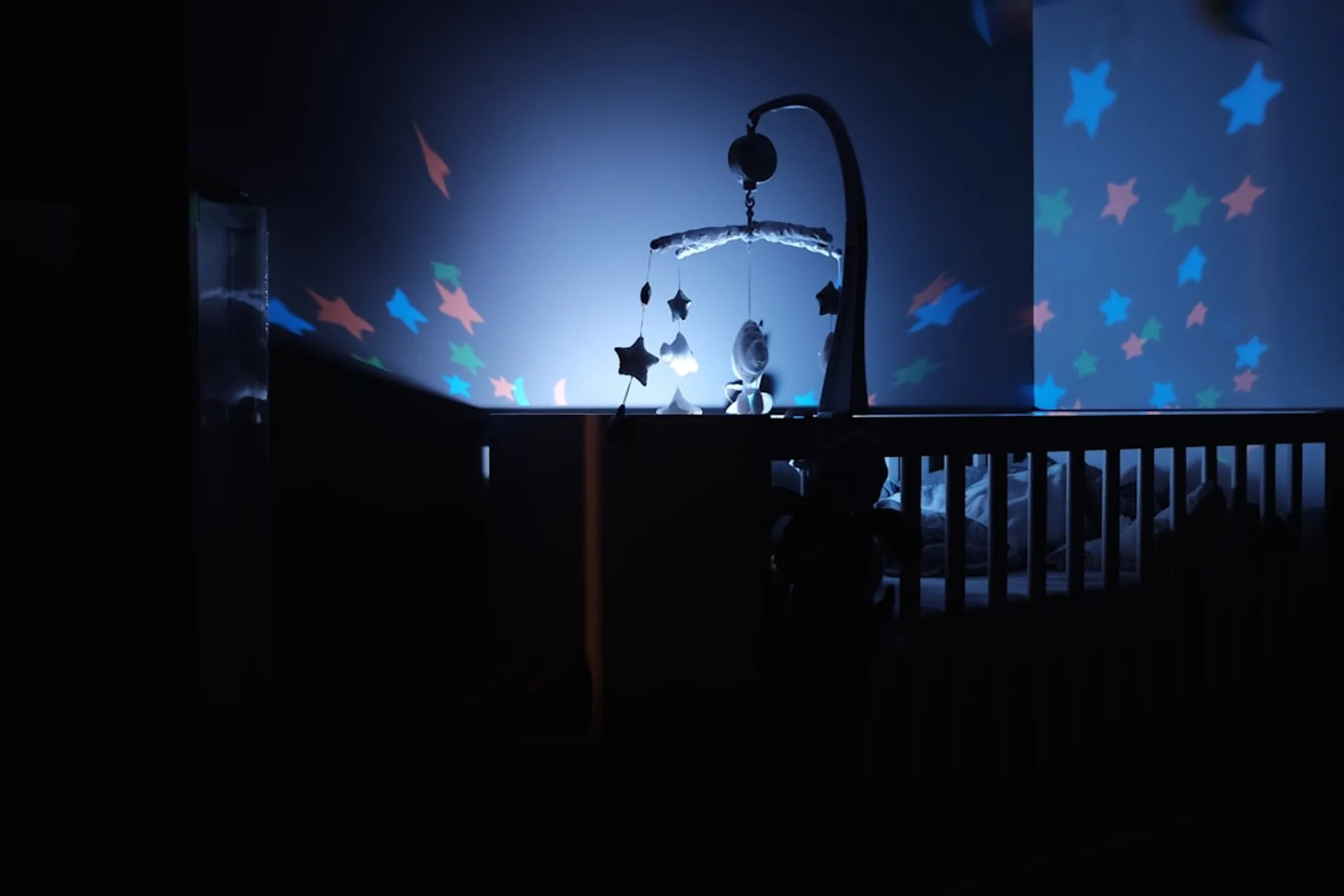
A sound machine for baby sleep is a speaker or app that plays steady background audio (white noise, pink noise, brown noise, or nature loops) to mask sudden household sounds and cue rest. Newborns wake easily during light sleep when a floor creak or door click breaks a quiet room. Keep volume low: a steady mask below safe limits works better than a loud track.
This guide covers nursery safety: decibel targets, crib distance, sound type, timer length, and whether a phone app or dedicated device fits your routine. For general volume calibration, see sound volume and sleep quality. For playback duration basics, read sleep sounds all night vs timer.
Key takeaways
- Keep nursery audio between 40 and 50 dB at mattress height; measure with a decibel app.
- Place the speaker 3 to 6 feet from the crib edge, never inside the crib.
- Choose steady loops (white, pink, brown, or seamless rain) without lyrics or spikes.
- Use a timer if sleep onset is the main struggle; run all night if silence wakes your baby.
- Audio supports healthy sleep habits but does not replace pediatric care for feeding, reflux, or apnea concerns.
Why steady sound can help infants
Inside the womb, babies hear a continuous mix of blood flow, digestion, and muffled external noise. After birth, a quiet room can make every floor creak or door click feel sharp. Steady background audio raises the nursery noise floor so brief sounds blend in rather than stand out during light sleep.
Some small studies suggest white or pink noise may shorten sleep onset in noisy settings, though evidence is mixed and results vary by child. Masking unpredictable spikes from siblings, traffic, or HVAC clicks is the clearest everyday win. Pair sound with a dark room, safe swaddling or sleep sack, and a consistent bedtime routine.
For research context on broadband noise, read can white noise help you sleep better. Adult findings do not map perfectly to infants, but the masking principle is similar.
Safe volume for a nursery sound machine
Volume is the variable parents control most directly, and it matters more than whether you pick white or pink noise. Pediatric and hearing-health sources often cite roughly 50 dB as an upper guideline for infant exposure in the sleep space. A practical starting band is 40 to 50 dB at the crib mattress, comparable to soft rain heard from across a room.
Measure at ear level, not at the speaker. Levels at the nightstand can read 5 to 10 dB higher than at the mattress. Use a decibel meter app, play your usual track, wait 10 to 15 seconds for a steady reading, then adjust in small steps. If you need to raise your voice to talk over the sound at the crib rail, it is probably too loud.
Signs to lower volume include your baby startling when the track loops, fussing only on nights the machine runs, or you creeping the level up week after week. A lower setting with better placement often masks just as well without the same exposure.
Crib distance and speaker placement
Distance protects hearing and spreads sound evenly. A common target is 3 to 6 feet (about 1 to 2 meters) from the crib edge to the speaker grille. Place the device on a dresser or shelf, never inside the crib, on the mattress, or clipped to the rail where a curious hand can reach cords.
Angle the speaker upward toward the ceiling or toward the foot of the crib rather than directly at the baby's head. Bounced sound fills the room at a lower perceived intensity, which often lets you keep volume conservative. Keep cords tucked behind furniture and out of reach.
Travel cribs and bassinets need the same rules in smaller spaces. In a hotel room, put the speaker on the bathroom counter with the door cracked if that keeps distance without blasting the bassinet. For sleep-sound fundamentals, see sleep sounds basics.
Best steady sounds for baby sleep
| Sound type | What it sounds like | When parents try it |
|---|---|---|
| White noise | Even hiss, like a fan or static | Newborns; noisy apartments; sharp household spikes |
| Pink noise | Softer whoosh, like steady rainfall | Longer playback; babies sensitive to bright hiss |
| Brown noise | Deep rumble, like distant wind | Older infants; masking low rumbles from traffic or HVAC |
| Nature loops | Seamless rain or ocean without bird calls | Parents who want a less synthetic texture |
Skip tracks with lyrics, spoken stories, or intermittent peaks (doorbells, thunder claps, bird chirps). They pull a baby's attention at bedtime. If your baby startles at loop seams, switch to a different file or app preset with a cleaner loop point.
Run the same sound for at least several nights before switching. Infants adapt slowly, and changing tracks nightly makes it hard to know what helped.
Timer vs all-night playback
| Option | Pros | Cons |
|---|---|---|
| Timer (30–60 min) | Less total exposure; matches sleep-onset help | Baby may notice when audio stops if the room is still noisy |
| All-night | Masking continues through early-morning cycles | Requires discipline on volume; phone battery drain on apps |
A 30 to 60 minute timer aligns with the first sleep cycle for many families. If your baby wakes when playback ends, extend to 90 minutes or switch to all-night at the same measured volume rather than turning it louder. A gradual fade over two to five minutes beats an abrupt stop at full level.
Some infants outgrow nightly masking after several months as sleep patterns mature. Others keep using low-level sound through toddlerhood, especially in shared bedrooms. Watch how your child sleeps and adjust. No single end date fits every family.
App vs dedicated nursery device
Phone and tablet apps are the fastest way to test whether steady sound helps your baby. They offer many tracks, timers, and volume sliders you already know how to use. Downsides include notification pop-ups, screen glow if the display stays on, and battery drain during all-night playback.
Dedicated nursery machines (often called baby noise machines or sound machines for the nursery) usually include hardware buttons, preset loops, optional night-lights, and no text messages at 2 a.m. They cost more up front but remove one phone from the bedside.
Either approach works when you mute alerts on apps, keep volume in the 40 to 50 dB band, and maintain crib distance. A small Bluetooth speaker driven by an app on a plugged-in tablet is a reasonable middle ground for travel.
Common myths about baby sleep machines
Myth: White noise creates permanent dependency. Many children taper off masking as sleep consolidates. Steady audio masks the room; self-soothing skills still develop on their own timeline.
Myth: Louder white noise blocks more. Loudness raises hearing exposure regardless of frequency. Past roughly 50 dB at the crib, comfort and safety tradeoffs worsen faster than masking improves.
Myth: Hardware machines are always safer than apps. You set the safety baseline with volume, distance, and cord management. A dedicated device played too loud beside the crib is worse than a well-placed app speaker at 42 dB.
Myth: Every baby needs a sound machine forever. Try a week without audio after a few months if nights are stable. Some families keep low-level sound for siblings in shared rooms; others stop once the nursery stays quiet enough.
Medical disclaimer: Nursery sound guidance supports healthy sleep routines but is not a substitute for pediatric medical advice, diagnosis, or treatment. Consult your pediatrician if you have concerns about your baby's hearing, breathing during sleep, feeding, reflux, or sleep patterns that do not improve with safe habits.
Nursery sound machine checklist
- Measure 40 to 50 dB at mattress height with a decibel app.
- Place the speaker 3 to 6 feet from the crib edge, cords out of reach.
- Pick one steady loop without lyrics or sudden spikes.
- Choose a 30 to 60 minute timer or all-night mode based on when your baby wakes.
- Re-check volume monthly; avoid gradual volume creep.
- Stop and ask your pediatrician about hearing or sleep concerns that persist.
For white noise setup details aimed at adults (many principles overlap), see white noise for sleep. Pair this checklist with a dark, cool room and a predictable bedtime sequence.
A sound machine for baby sleep works best when volume stays conservative, placement stays consistent, and you give each setting several nights before changing tracks. Whether you use a nursery device or a phone app on the dresser, the same safety rules apply: measure, place, and keep the sound steady enough to ignore.